Recruitment Process Outsourcing (RPO): When to Hand Off Your IT Hiring Process
 Max Lefstad

Your IT roadmap for next year has a dozen new roles on it. There are three software engineers, two data engineers, a cloud architect, and a handful of security analysts. Your company's recruiters are already carrying a full load from every other department, and your hiring managers are spending afternoons screening resumes instead of shipping work.
Filling roles one at a time with a staffing partner works well for a few openings. At this volume, though, you need something closer to a recruiting team.
That's where recruitment process outsourcing comes in. Recruitment process outsourcing (RPO) is a hiring model where an outside partner takes over all or part of your recruiting process, from sourcing and screening to interview scheduling and offers. A staffing engagement fills a specific role, while RPO runs the process behind many roles. It makes the most sense when you're hiring for many similar roles at once, your internal recruiters can't keep pace, or you need a repeatable hiring process you don't have time to build.
Why Are More IT Teams Looking at RPO Right Now?
Recruiters are being asked to do more with the same resources. SHRM's 2026 Recruiting Executives Benchmarking data, drawn from more than 4,600 organizations, found that extra-large organizations saw a 67% increase in median requisitions per recruiter this year. The median time to fill a nonexecutive role was 39 calendar days.
At the same time, the bar for a good hiring process keeps rising. Gartner's August 2026 research on attracting top IT talent points out that candidates' expectations are changing faster than traditional hiring practices, and that gap is leading to more turned-down offers.
Put those together and the hiring process itself becomes the bottleneck. When every recruiter is stretched across dozens of openings, technical roles tend to wait longest, because they're the hardest to screen well. RPO gives you a dedicated team and a defined process for that work.
How Does RPO Work?
An RPO partner works as an extension of your talent acquisition team. They often recruit under your company's name, follow your hiring process (or help you improve it), and report on results. You still make the final hiring decisions, and every hire joins your payroll.
Depending on the engagement, an RPO partner may handle:
- Writing and posting job descriptions
- Sourcing candidates, including people who aren't actively job hunting
- Screening resumes and running technical assessments
- Scheduling interviews and coordinating with hiring managers
- Managing offers and keeping candidates engaged through acceptance
- Reporting on time to fill, pipeline health, and quality of hire
RPO engagements usually come in three sizes, according to the Recruitment Process Outsourcing Association:
- Full-process RPO: The partner handles recruiting across all roles and departments.
- Selective RPO: The partner handles specific roles, teams, or locations, such as all of your engineering hiring, while your internal team covers the rest.
- Project RPO: The partner fills a set number of openings on a defined timeline, like staffing a new data team over six months.
For most IT teams, selective RPO is the best fit. The partner takes ownership of your technical hiring, the roles that are hardest to fill, while your internal recruiters keep handling everything else. Project RPO can work as a short trial before you commit to an ongoing program.
How Is RPO Different From Contract Staffing?
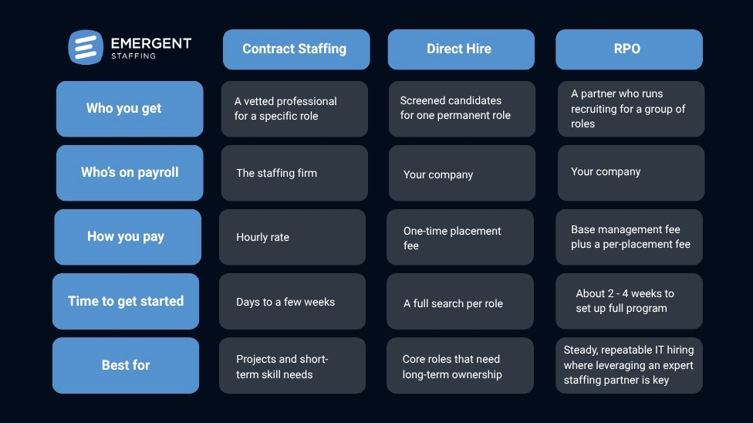
RPO and contract staffing solve different problems, and the same partner can often provide both. Contract staffing puts a vetted professional into a specific role, and that person stays on the staffing firm's payroll. Direct hire staffing finds candidates for one permanent role in exchange for a one-time fee. RPO takes responsibility for the recruiting process across a group of roles, and the people hired go straight onto your payroll.
Here's how the three compare:
If you're weighing the first two models for an individual role, we break that decision down in Contract, Contract-to-Hire, or Direct Hire: Which IT Hiring Model Fits the Role?
When Does RPO Make Sense for an IT Team?
RPO is a good fit when hiring is steady and repeatable enough that a dedicated process pays for itself. Signs that it's time to consider it include:
- You're hiring in volume. A new engineering team, a data platform build-out, or a security program expansion can mean months of related hiring.
- Your internal recruiters are stretched. If IT reqs sit in the same queue as every other department's, technical roles tend to stall.
- Hiring managers are doing the screening. When engineers and architects spend hours reviewing resumes, their own work slows down.
- You need consistent technical screening. RPO gives every candidate the same assessment process, which makes it easier to compare people fairly.
- You want better hiring data. A good RPO partner reports on where candidates come from, where they drop out, and how long each step takes.
RPO is usually the wrong fit for one or two openings, or for short-term project work. In those cases, direct hire or contract staffing will be faster and simpler. For project work, see IT Staff Augmentation: What It Is, How It's Different, and When It's the Right Call.
What Should You Ask Before Choosing an RPO Partner?
The right partner should understand technical hiring as well as recruiting operations. Before you sign, ask:
- How do you screen technical skills? Look for role-specific assessments and technical interviews, not keyword matching.
- Will you recruit under our brand? Candidates should have a consistent experience that reflects your company.
- What's included in the pricing? RPO pricing is often a monthly management fee, a per-hire fee, or a blend of the two. Ask how costs change if hiring slows down.
- What will you report on, and how often? Agree on metrics like time to fill, offer acceptance rate, and quality of hire up front.
- Can you also provide contract talent? If a project needs someone next week, a partner who does both can fill the gap without a second vendor.
Frequently Asked Questions
What does RPO stand for in staffing?
In staffing, RPO stands for recruitment process outsourcing. IT teams may also know RPO as recovery point objective, a disaster recovery term, but the two are unrelated.
Is RPO more expensive than using a staffing agency?
It depends on how many people you're hiring. For a steady stream of similar roles, RPO can lower your cost per hire because the partner builds one process instead of starting a new search for every opening. For one or two roles, a traditional staffing engagement is usually more cost-effective.
How long does it take to start an RPO program?
A selective RPO program, where the partner takes over a specific group of roles like IT hiring, typically takes 4 to 8 weeks to set up, according to the Recruitment Process Outsourcing Association. A project program can start in about two weeks, while a full-process program covering every department takes 8 to 12 weeks.
Can you use RPO and contract staffing at the same time?
Yes. Many IT teams use RPO for permanent hiring and contract staffing for project work or short-term gaps. Using one partner for both keeps screening standards consistent across every hire.
How Emergent Staffing Can Help
Emergent Staffing is an IT staffing firm based in the Twin Cities, Minnesota. We place software engineers and cloud, data, and cybersecurity professionals through contract, contract-to-hire, and direct hire staffing, We also offer selective recruitment process outsourcing, where we take over your technical hiring, such as engineering, data, or security roles, while your internal team handles the rest.
Every candidate goes through the same candidate screening process, including technical assessments, recruiter interviews, and role-based challenges. Thorough screening doesn't have to slow things down. Over the past 90 days, our median time to hire across contract and direct hire positions was 15 days.
Whether you need one engineer next week or a recruiting team for next year's roadmap, we'll help you choose the approach that fits. Learn more about our IT staffing services.