Legacy System Modernization: The Hidden Staffing Challenge
 Max Lefstad

Introduction
Legacy system modernization rarely fails because a company picked the wrong cloud platform or underestimated a licensing cost. Most often, the problem is simpler: the people expected to modernize the environment are the same people responsible for keeping it running.
That creates a capacity problem almost immediately. Your best engineers are supposed to plan migrations, untangle integrations, refactor applications, and make decisions about what comes next. At the same time, they're still answering tickets, patching servers, responding to incidents, and supporting the systems the business relies on today.
A recent CIO.com piece on rethinking the rip-and-replace mindset makes an important point: technical capacity can be a bigger constraint on modernization than capital. Funding the project is only part of the equation. You also have to create room for the people doing the work.
Because your current systems don't stop needing care just because you've decided to replace them.
Here's how to build a legacy system modernization plan that accounts for the people doing the work as well as the technology.
What Is Legacy System Modernization?
Legacy system modernization is the process of updating or replacing older software, infrastructure, or applications so they can keep supporting the business. These are usually systems your company depends on every day: custom-built applications, on-premises databases, aging servers, or integrations held together by code nobody wants to touch.
Modernization can take several forms. The most common legacy modernization approaches include:
- Rehosting: moving an application to new infrastructure, often the cloud, with few code changes.
- Replatforming: making targeted changes so the application runs better on a new platform.
- Refactoring: restructuring the code to improve performance, security, or maintainability.
- Replacing: retiring the system and moving to a new application entirely.
- Retaining: keeping the system as it is, with better monitoring, security, or support around it.
Each option asks something different of your team. Rehosting leans on cloud architecture and infrastructure skills. Refactoring needs software engineers who can read older code and write modern code. Replacing a system means data migration, integration work, and a long stretch of running two environments side by side.
Is Replacing a Legacy System Worth It?
Age alone isn't a good enough reason. A system that's stable, secure, and still meeting the business's needs may not be worth the disruption of replacing it, at least not yet.
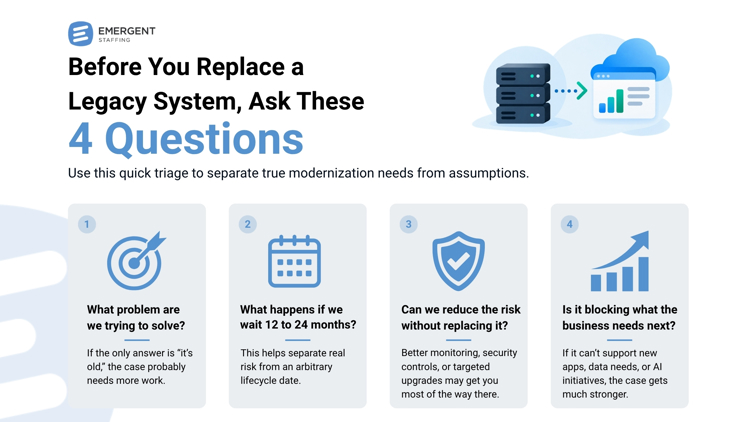
This kind of triage is also a good time to look for overlap. If you're running several tools that do similar jobs, addressing the hidden cost of too many business applications can shrink your modernization list before it starts.
Why Team Capacity Is the Constraint Most Plans Miss
Most legacy modernization strategies are built around budgets, timelines, and technology choices. Far fewer account for how many hours the team really has available.
Your infrastructure and engineering teams can't pause their day jobs for a year. Systems still need patching, incidents still need answers, and users still need support. When modernization work gets stacked on top of all that, something gives. Usually it's the project, which slips quietly week by week, or the team, which burns out trying to do both.
There's also an opportunity cost. Every month your senior engineers spend replacing a system that could've safely run another two years is a month they aren't spending on work that moves the business forward.
Modernization rarely happens in isolation right now, either. AI initiatives, cloud cost pressure, and rising security expectations are all competing for the same group of experienced people. And since your AI strategy is only as strong as your data, your modernization timeline and your AI timeline are often tied together, whether you planned for that or not.
How to Build a People Plan Into Your Legacy Modernization Strategy
Once you know which systems need to change, map out who'll do the work and what they'll stop doing to make room for it. A few approaches tend to work well.
Split run work from change work. Decide who owns day-to-day operations and who owns the modernization effort. Giving everyone a little of both usually means neither gets enough attention.
Use contract talent to cover the run side. Your senior engineers know your systems best, so they're often the right people to lead modernization. Backfilling their routine support work with skilled contractors frees them up without leaving operations exposed.
Add specialists for the migration itself. Some skills, like cloud architecture, data migration, or refactoring older code, are needed heavily during a project and much less afterward. IT staff augmentation lets you add that expertise for the length of the work without adding permanent headcount.
Plan for knowledge transfer early. Legacy systems often depend on what a few long-tenured people know. Pair outside help with those people from day one so that knowledge gets documented and shared before the old system goes away.
Match the staffing model to the work. Not every gap calls for the same fix. Our guide on when to hire, contract, consult, or use a managed service breaks down which option fits which kind of work.
If your 2027 budget is still taking shape, now's the time to plan for this. We cover how in Building Staffing Flexibility Into Your 2027 IT Budget.
Signs Your Modernization Effort Needs More Hands
If any of these sound familiar, capacity is probably the bottleneck:
- The project timeline has slipped more than once, and the reason is always “competing priorities.”
- Ticket backlogs or incident response times have crept up since the project started.
- Only one or two people understand how the legacy system works.
- Your team is choosing technology based on what they already know instead of what fits best.
- Senior engineers spend more time on maintenance than on design and planning.
How Emergent Staffing Can Help
Emergent Staffing helps IT leaders add the right technical talent for modernization work. That could mean software engineers who can refactor older applications, cloud and data professionals for a migration, or contract support to keep current systems running while your team focuses on what's next. Through our contract and direct hire IT staffing services, we deliver candidates who've been through thorough technical vetting, so they can contribute quickly instead of needing months to ramp up.
If your legacy system modernization plan is ready but your team's calendar isn't, let's talk about where outside help would make the biggest difference.