Building Staffing Flexibility Into Your 2027 IT Budget
 Max Lefstad

Introduction
It's September, and if you're an IT leader, that probably means one thing: budget season. Over the next few weeks, you'll be asked to put a number on next year's headcount, tools, and projects. Once that number is approved, you'll likely be living with it for all of 2027.
Here's the problem. You're being asked to predict what your team will need for the next twelve months before you know. New projects will come up that no one has mentioned yet, priorities will shift, someone on your team may leave without much warning, but once your 2027 budget is locked in, asking for more headcount mid-year is a hard conversation to have.
There's a way to plan around this. Instead of building your budget around fixed headcount alone, you can build in flexibility from the start. That means planning for a mix of full-time employees, contractors, and consultants, not just picking one and hoping it covers everything.
Why This Budget Season Feels Different
Every budget season comes with pressure, but this one has a few extra layers.
AI tools and infrastructure are competing with headcount for the same dollars. Leadership wants to see AI investment, and that money must come from somewhere. At the same time, many companies are still moving slowly on new hires, so open positions sit unfilled for months. On top of that, finance teams are asking harder questions about cost discipline across the board, not just in IT.
Put those together, and you get an environment where asking for five new full-time hires is a tough sell, even if the work is real. Leadership isn't necessarily saying no to more support. They're saying no to more fixed cost without a clear plan for how it will be used.
Think about how this plays out in a typical budget meeting. You ask for three new full-time roles to cover an expected project load. Finance asks what happens if that project gets delayed, or if it comes in smaller than expected. If you don't have a good answer, that headcount request often gets trimmed, deferred, or sent back for more justification. Nobody wins in that scenario. Your team still needs the support, and now you've lost weeks going back and forth over a number instead of solving the actual problem.
That's exactly why flexibility matters more this year than in past years. A plan that can flex up or down with actual demand is a much easier conversation than a fixed number that assumes everything goes as expected.
The Real Cost of a Full-Time Hire vs. Contract vs. Consultant
Before you can build flexibility into your budget, it helps to understand what you're comparing.
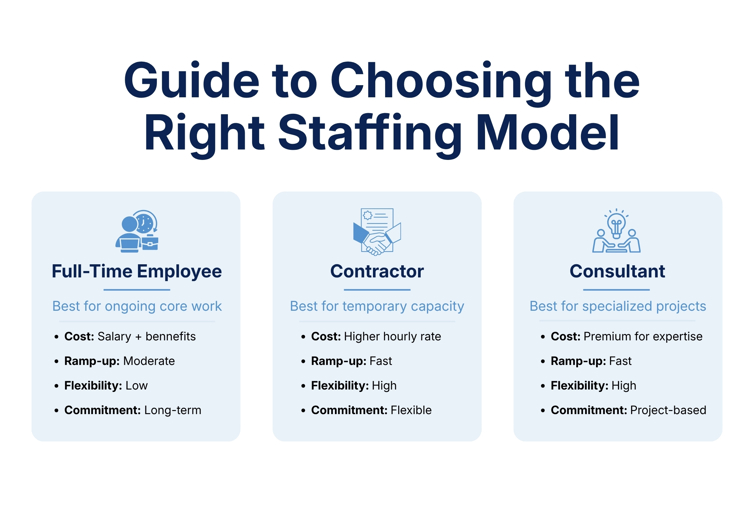
A full-time hire, often called an FTE (short for "full-time equivalent"), costs more than just their salary. Add in benefits, payroll taxes, equipment, and onboarding time, and the real cost usually lands 25 to 40 percent above base salary. Then there's ramp-up time. A new hire often takes several months before they're fully productive, and that time isn't free.
A contractor typically bills at a higher hourly or weekly rate than what an employee earns for similar work. But there's no long-term commitment, no benefits cost, and no severance if the need goes away. Contractors are often ready to contribute much faster, especially when the work is clearly scoped.
A consultant or consulting team costs more per hour than either of the above, because you're paying for expertise, structure, and speed on a defined outcome, not just hands-on-keyboard time. For focused, complex projects, that premium is often worth it. Consultants can also shrink the risk that comes from your team stretching to cover skills gaps.
None of these options is automatically "cheaper." The right choice depends on whether the work is ongoing or temporary, and how much ramp-up time you can afford. A budget built entirely around full-time hires ignores the fact that some of your work simply isn't full-time work.
A Simple Framework for Building Flex Capacity Into Your 2027 Plan
You don't need a complicated model to start building flexibility into your budget. A few steps will get you most of the way there.
First, sort your team's work into two buckets: core and steady work, and variable, project-based work. Core work supports the systems and processes your business depends on every day. Variable work includes things like a migration, a new platform rollout, or a temporary spike in support tickets.
Second, budget your core work with full-time roles. This is where continuity and institutional knowledge matter most, so long-term hires make sense here.
Third, set aside a percentage of your budget, not a specific headcount, for flexible capacity. Instead of asking for two more full-time hires, ask for a flexible staffing budget that can flex toward contract or consulting support as the year unfolds. This gives you room to respond to whatever happens in 2027, instead of guessing today.
Fourth, identify a staffing partner before you need one. Waiting until a gap shows up to start looking for contract or consulting help means losing weeks you don't have. Lining up a partner during planning season means you can move quickly when the need is real.
None of this requires a perfect forecast. The goal isn't to predict exactly what will happen in 2027. It's to build a plan that can absorb the unexpected without a new round of budget approvals every time something changes.
Why the Conversation Should Start Now, Not in Q1
Most IT leaders wait until a gap appears to think about contract or consulting support. By then, they're under pressure, the timeline is tight, and their options are more limited.
Starting the conversation during budget season instead of after a gap shows up gives you real advantages. You get better rates, because you're not asking for emergency turnaround. You get a partner who already understands your environment, because there's been time for a real conversation instead of a rushed one. And you get to shape your 2027 plan around what's available to you, instead of guessing and hoping it works out.
Budget season isn't just about getting a number approved. It's a chance to build a plan that can flex when your business needs it to.
How Emergent Staffing Can Help
You don't have to figure out your 2027 staffing mix on your own. Emergent Staffing works with IT leaders throughout the year, not just when a gap becomes urgent, but to help plan for the right combination of full-time, contract, and consulting talent.
If you're heading into budget season and want a second set of eyes on your staffing plan, we're glad to help you think it through before the numbers are locked in.