Who’s Watching Your AI Spend?
 Max Lefstad

Introduction
Many organizations are moving quickly with AI. Teams are testing productivity tools, embedding AI into workflows, launching internal assistants, and experimenting with more advanced use cases. Early successes often create momentum because the technology can deliver visible results with relatively little upfront investment.
As adoption expands, a different challenge starts to emerge. AI costs can grow in ways that are difficult to predict, especially when usage spreads beyond a pilot group and becomes part of daily operations. An initiative that looks inexpensive during testing can have a very different cost profile once hundreds of employees begin using it regularly.
Organizations that scale AI successfully tend to focus on cost visibility early. They understand how AI consumption works, which activities drive spending, and how those costs connect to measurable business outcomes.
Why AI Spend Behaves Differently Than Traditional IT Spend
Most technology leaders are accustomed to managing predictable expenses. Software licensing, infrastructure contracts, and support agreements typically follow established pricing models that make forecasting relatively straightforward.
AI introduces a different dynamic. Costs are often tied directly to activity, meaning spending can increase as usage increases. Every prompt, workflow, automation, or AI-generated response consumes resources, and those resources have a cost associated with them.
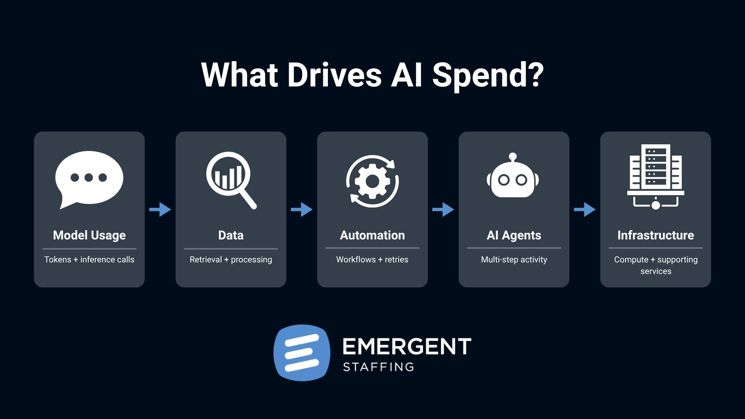
Because consumption drives many of these costs, spending patterns can change quickly as adoption grows. A tool that seems affordable when used occasionally can generate substantially higher costs once it becomes part of everyday work across multiple teams.
AI Pilots Rarely Show the Full Cost Picture
Pilots are a valuable part of AI adoption. They allow organizations to evaluate technology, identify useful applications, and build confidence before making larger investments.
The challenge is that pilot environments rarely reflect what happens in production. Usage is usually limited, data sources are carefully controlled, and the number of users remains relatively small. Those conditions provide helpful insights about functionality, but they often provide an incomplete picture of long-term costs.
Once AI becomes embedded in business processes, the environment changes. More users gain access, additional workflows are automated, and integrations connect AI tools to more systems and data sources. As activity grows, consumption grows with it.
Understanding this shift helps organizations make better decisions about budgeting and governance before usage expands significantly.
Technical Decisions Shape AI Costs
One reason AI cost management has become an IT leadership issue is that many spending drivers originate in technical decisions.
Architecture choices influence how frequently AI models are called, how much data is processed, which models are used, and how workflows are designed. Small design decisions can create meaningful differences in consumption over time, especially when thousands of transactions occur each day.
For example, an application might retrieve more information than necessary for every request. An automated process might retry failed tasks repeatedly. A workflow could rely on a more expensive model when a simpler option would produce a similar result.
These choices often happen months before finance teams see the impact on a budget report. Managing AI spend effectively requires visibility into the technical behavior that creates those costs.
AI Cost Governance Requires Shared Accountability
Finance teams play an important role in understanding AI investments. They help monitor budgets, track spending trends, and evaluate whether projects are delivering value.
The challenge is that financial data alone rarely provides enough context. A jump in spending could indicate strong adoption and positive business results. It could also signal inefficient workflows, duplicated activity, or architectural issues that need attention.
This is why AI cost governance works best when finance, IT, engineering, and business leaders maintain shared visibility. Finance teams help identify where money is being spent. Technical teams explain why the spending occurs. Business leaders determine whether the outcomes justify the investment.
When those groups work together, organizations gain a much clearer picture of both cost and value.
What IT Leaders Should Be Watching
AI adoption does not require monitoring every technical metric available. A handful of high-level questions can provide meaningful visibility into where costs are coming from and whether those costs remain aligned with business goals.
IT leaders should pay close attention to:
- Which teams and workflows generate the most AI activity
- Which models or services drive the highest costs
- Whether usage delivers measurable business value
- Where automation or AI agents create unexpected consumption
- Whether guardrails are in place before usage scales further
The goal is visibility, not restriction. Organizations can support innovation while maintaining a clear understanding of how AI resources are being consumed.
Cost-Aware AI Requires New Capabilities
Managing AI spend effectively requires both technical and operational expertise. Someone needs to understand how AI systems consume resources, how architecture decisions influence cost, and how those costs connect to business outcomes.
Several disciplines often contribute to this effort:
- Cloud architecture and infrastructure
- AI and machine learning engineering
- Data engineering
- Platform engineering
- FinOps and usage optimization
Few organizations need dedicated specialists in every area immediately. What matters is understanding which capabilities already exist internally and which gaps could limit visibility or control as AI adoption grows.
As AI becomes a larger part of technology strategy, cost governance is becoming its own technical capability.
Waiting Creates More Expensive Problems
Many organizations begin thinking about AI cost controls after usage has already expanded across the business. By that point, workflows are established, integrations are built, and teams have become dependent on existing processes.
Adjusting those systems later can be significantly more difficult than designing them thoughtfully from the beginning. Leaders may find themselves trying to explain rising costs, justify budgets, or redesign expensive workflows that are already widely adopted.
Building accountability early creates more flexibility. Teams gain a better understanding of what drives consumption, which use cases create value, and where spending should be monitored more closely.
Organizations that address these questions early often scale AI with fewer surprises.
Where Staffing Becomes Part of the Conversation
Managing AI costs often requires skills that extend beyond model development. Organizations may need professionals who understand cloud architecture, data engineering, platform engineering, infrastructure, AI/ML, monitoring, and cost optimization. For companies that do not have all of those capabilities internally, hiring the right technical talent becomes an important part of building a sustainable AI strategy.
That is also where the staffing partner matters. Emergent Staffing goes beyond resume matching by using deeper technical vetting to help determine whether candidates actually have the skills required for complex IT roles. Our team also takes a more hands-on, collaborative approach, working as an extension of your hiring team to understand your environment, goals, and technical needs before presenting candidates.
AI Adoption Is Easier to Scale When Costs Are Understood
AI adoption continues to accelerate, and most organizations are still in the early stages of understanding how AI spending behaves over time. Costs can increase quickly when usage expands, workflows become more automated, and new systems are connected.
Leaders who understand how AI costs are created are in a much stronger position to guide adoption responsibly. Visibility into usage, architecture, data, automation, and business outcomes helps ensure that AI investments remain aligned with company goals.
As AI becomes a larger part of everyday operations, cost accountability will become a standard part of AI strategy. Organizations that develop that discipline early will be better positioned to scale AI with confidence.
How Emergent Staffing Can Help
Organizations do not need to slow AI adoption to improve cost visibility. They need the right expertise involved in the process. Emergent Staffing helps companies identify and hire technical professionals across cloud, data, platform, infrastructure, AI/ML, and other specialized IT disciplines that can support responsible, scalable AI adoption.
Need technical talent that can help keep AI adoption aligned with business value?
Emergent Staffing can help you identify and add deeply vetted cloud, data, platform, AI, and FinOps-minded professionals who have the skills to support your AI initiatives as they grow.