Inside the Technical Vetting Process: The Candidates You Never See
 Charlotte Nygaard

What Happens Before a Resume Reaches the Hiring Manager?
When a hiring manager receives one to three resumes from a staffing partner, it can seem like those were simply the first qualified applicants. However, those candidates are usually the result of a much larger process, one that starts with hundreds of potential applicants and narrows quickly through screening, conversations, and evaluation.
To better understand what happens before a candidate reaches a client, I spoke with Charlotte Nygaard, a Senior Technical Recruiter at Emergent Staffing. Her perspective sheds light on how much evaluation happens behind the scenes before a resume is ever submitted.
A resume is just the starting point. Before a candidate is presented, recruiters are evaluating technical fit, communication, motivation, compensation, work authorization, location, professionalism, and overall alignment with the role and team.
The candidates you see are only the final result of that work. Behind every submission are dozens, sometimes hundreds, of decisions about who moves forward and who doesn’t.
Looking Qualified on Paper Is Only the Starting Point
A strong resume can get a candidate into consideration, but it doesn’t guarantee they’ll be submitted to a client. In many cases, the initial impression holds up. In others, it doesn’t.
As Charlotte explains:
“It’s often a combination of factors that influences whether a candidate moves forward. While a resume may look strong on paper, deeper conversations can reveal gaps that aren’t immediately obvious.”
Technical alignment is often the first filter. Candidates may list technologies they’ve used without having the depth required for the role. Or they may have adjacent experience that doesn’t fully match the core responsibilities.
Even when technical skills align, other factors can quickly shift the decision:
- Communication challenges in roles that require collaboration
- Compensation expectations outside the range
- Work authorization or location constraints
- Limited interest in the opportunity
Charlotte puts it simply:
“Our goal is not simply to find qualified individuals; we want to identify candidates who are positioned for long-term success in both the role and the organization.”
This is where many “qualified” candidates are filtered out, not because they aren’t strong professionals, but because the fit isn’t right for that specific role.
What a Recruiter Conversation Reveals That a Resume Cannot
A resume can show what someone has worked on, but it doesn’t capture how they think, communicate, or collaborate.
That’s where the initial recruiter conversation becomes critical, adding context that a resume alone can’t provide.
Charlotte explains:
“A resume tells you what someone has done, but a conversation helps you understand who they are.”
In a single conversation, recruiters can assess things that don’t show up clearly on paper:
- How a candidate explains complex work
- How they approach challenges or setbacks
- Whether they take ownership of decisions
- Their level of enthusiasm and interest
These insights often change the trajectory of a candidate’s evaluation.
Sometimes a candidate who doesn’t check every technical box stands out because of how they communicate, learn, and adapt. Strong interpersonal skills, coachability, and self-awareness can outweigh smaller technical gaps, especially in roles where collaboration matters.
From a hiring manager’s perspective, this step reduces uncertainty. It ensures that by the time a candidate reaches you, someone has already pressure-tested how they think and operate, and not just what they’ve listed on their resume.
Why Assessments and Video Interviews Matter
Beyond conversations, additional screening steps provide validation. They help confirm whether what a candidate claims aligns with how they work.
Charlotte describes their value clearly:
“These additional screening steps provide valuable validation and context that a resume alone simply cannot offer.”
Technical assessments are one of the most effective tools in this stage. They show how a candidate approaches real problems. Do they think methodically? Do they communicate their process? Can they apply what they know in a practical way?
Video interviews add another layer. They give insight into:
- Professional presence
- Communication clarity
- Engagement and responsiveness
These signals matter, especially for roles that interact with business stakeholders, clients, or cross-functional teams.
References and additional checks help round out the picture. No single step determines the outcome, but together they create a much clearer view of the candidate.
For hiring managers, this means fewer surprises later in the process.
The Difference Between a Qualified Candidate and a Standout Candidate
Not all qualified candidates are equal.
Some meet the requirements. Others demonstrate a level of depth that makes them stand out immediately.
“A qualified candidate can often answer questions with straightforward responses, but a standout candidate provides meaningful context.” Charlotte explained.
Standout candidates go further. They don’t only say what they’ve done but also explain:
- Why they made certain decisions
- What challenges they faced
- What impact their work had
They can take you inside their work, not just summarize it.
Another key differentiator is communication. Strong candidates can explain complex technical concepts in a way that non-technical stakeholders understand. That ability becomes critical in many modern IT environments.
As Charlotte notes, those are the candidates she’s most confident presenting, because they’ve already demonstrated both skill and clarity.
The Candidates Hiring Managers Never See
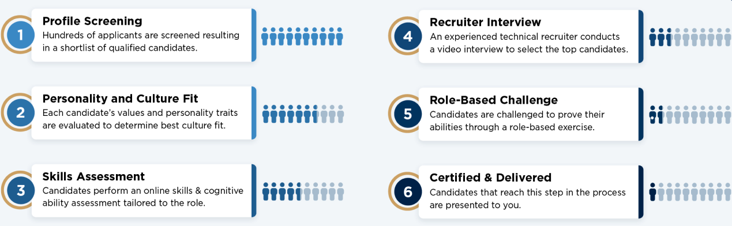
This is where the value of the vetting process becomes clear. Most hiring managers never see the scale of the initial talent pool.
Charlotte highlights just how large that pool can be:
“For many searches, we may start with a talent pool of 400 to 500 potential candidates.”
From there, the filtering begins; outreach, screening, conversations, assessments, and evaluations.
At each step, candidates are assessed for more than technical ability. Recruiters are also evaluating:
- Communication and professionalism
- Motivation and interest
- Compensation and logistics
- Team and cultural alignment
The result is a much smaller, highly refined group.
“By the time candidates are presented to a hiring manager, that initial pool has often been narrowed to just one to three highly vetted individuals.”
Those candidates represent dozens—sometimes hundreds—of decisions made before a resume ever reaches your inbox.
That unseen work is what allows hiring managers to focus on serious contenders instead of sorting through volume.
Why Fewer Candidate Submissions Can Be More Valuable
It’s easy to assume that more resumes mean a stronger search.
In practice, the opposite is often true.
A high volume of submissions shifts the screening burden back to the hiring manager. Instead of evaluating strong candidates, you’re spending time filtering through misalignment; skills that don’t quite match, compensation gaps, or candidates who aren’t fully engaged.
A smaller, curated shortlist changes that dynamic.
It allows you to:
- Spend more time with each candidate
- Focus on deeper evaluation, not initial screening
- Move faster with informed decisions
It also reduces wasted interviews, those situations where everything looks good on paper, but falls apart quickly in conversation.
A selective process doesn’t mean the search is limited. It means the work has already been done.
What Hiring Managers Can Do to Strengthen the Vetting Process
Even the strongest recruiting process works best as a partnership.
There are a few ways hiring managers can make that partnership more effective:
Clearly define must-have vs. preferred skills
This helps recruiters focus the search and avoid unnecessary trade-offs.
Provide context on the team and environment
Leadership style, pace, and expectations all influence candidate fit.
Align early on compensation and location
This prevents time spent on candidates who can’t realistically accept.
Offer specific feedback
The more detailed the feedback, the better the next round of candidates.
Stay open to transferable strengths
Candidates with the right mindset and adaptability can often grow into the role.
These inputs allow recruiters to refine faster and deliver stronger results.
Conclusion
The candidates a hiring manager interviews are only the visible end of a much larger process.
Behind every submission is a series of decisions; who to contact, who to screen, who to move forward, and who to filter out. Many candidates who appear qualified on paper never make it through that process because deeper evaluation reveals misalignment.
The candidates you do see have been evaluated across technical skill, communication, motivation, and long-term fit.
In many cases, a pool of hundreds has been narrowed to just a few.
That’s why a shortlist of one to three candidates isn’t a limitation, it’s the result of careful, deliberate vetting designed to help you spend your time where it matters most.
At Emergent Staffing, we work with teams that want a more focused approach to technical hiring.
One that prioritizes quality, reduces noise, and delivers candidates who are positioned to succeed.
Looking for a more focused approach to technical hiring?
Emergent Staffing helps organizations identify, evaluate, and present highly qualified technical professionals so hiring managers can spend less time sorting through resumes and more time meeting candidates who are positioned to succeed.