Hiring IT Talent in a Slow Market Is Harder Than Most Companies Expect
 Max Lefstad

Introduction
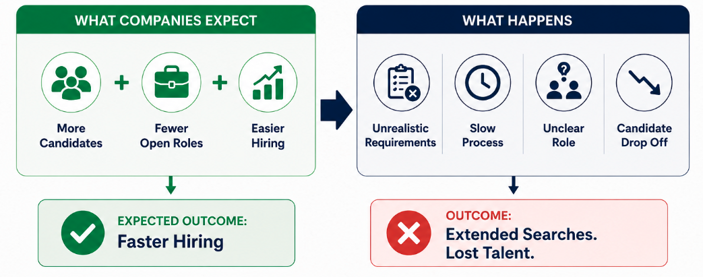
When the hiring market slows down, many companies assume hiring IT talent should become easier.
There are more candidates available, fewer open roles, and more uncertainty pushing people to look for stability. On paper, it looks like supply should finally outweigh demand.
Yet many hiring managers still struggle to fill critical technical roles; interviews stall, strong candidates drop out, and searches drag on longer than expected.
In most cases, the issue is not the market. It is the hiring process.
Even in slower markets, companies with unrealistic expectations, slow decision-making, unclear roles, or poor candidate experience continue to lose strong IT talent to organizations that operate with clarity and urgency.
A Slower Market Does Not Automatically Mean Easier Hiring
A common assumption in IT hiring is that more candidates lead to better results.
While applicant volume often increases during slower markets, quality does not increase at the same rate. Strong IT talent remains selective, especially engineers and technical leaders with proven experience. These candidates still have options, even when the market feels uncertain.
High-performing candidates evaluate more than job descriptions. They assess leadership stability, role clarity, team structure, and how efficiently a company makes decisions. When a hiring process feels disorganized or drawn out, candidates see it as a signal of internal friction.
Companies still need a strong hiring process to compete for top technical talent, regardless of market conditions.
Companies Often Become More Selective, and Slower
Slower markets tend to make hiring managers more cautious.
Budgets tighten, stakes feel higher, and teams hesitate to make the wrong hire. In response, expectations creep upward. Roles expand. Requirements multiply. Teams start searching for a perfect candidate rather than prioritizing what the role needs.
This often shows up when:
- Nice-to-have skills quietly become must-haves
- Multiple roles get bundled into one job description
- Teams hesitate to move forward unless every box is checked
While selectivity is reasonable, unrealistic expectations slow the process and reduce candidate engagement. Strong candidates sense hesitation and indecision, and many disengage before an offer is ever discussed.
Slow or Clunky Hiring Processes Lose Great Candidates
Speed remains one of the most underestimated factors in technical hiring.
Even in slower markets, strong candidates move quickly. They continue interviewing, they compare opportunities, and they respond to teams that respect their time.
Common breakdowns include delayed interview scheduling, too many interview rounds, slow internal feedback, and drawn-out decision-making after strong interviews. Each delay increases the chance that a candidate accepts another offer.
When companies move slowly, they often end up restarting the search. That means more time, more cost, and more frustration, all while wondering why strong candidates keep slipping away.
Even in slower markets, top IT talent does not wait.
Unclear Roles Create Hiring Problems
Role clarity is one of the most common failure points in IT hiring.
Unclear job descriptions, bloated scopes, and misalignment between stakeholders make recruiting harder than it needs to be. Candidates struggle to understand priorities, interviewers evaluate based on different criteria, and decision-making becomes inconsistent.
This usually happens when companies are not aligned internally. One stakeholder emphasizes delivery speed, another focuses on architecture, and another prioritizes leadership. Without clear agreement, the role becomes fuzzy.
If companies are unclear internally, recruiting becomes harder externally. Clear roles create clearer conversations, stronger pipelines, and better hiring decisions.
Candidate Experience Still Matters
There is a misconception that candidate experience matters less in slower markets.
In reality, it matters just as much. Candidates evaluate employers throughout the hiring process, not just at the offer stage. Communication delays, lack of transparency, poor coordination, and long periods without updates all send signals.
Strong candidates notice when companies communicate clearly, follow through on timelines, and provide honest feedback. When the experience feels frustrating or disorganized, candidates disengage, even if they are still interested in the role itself.
Poor candidate experience pushes strong talent toward companies that feel more decisive and better run.
What Companies That Hire Successfully Do Differently
Companies that continue to hire IT talent successfully during slower markets tend to focus on execution rather than external conditions.
They stay aligned internally, they keep requirements realistic, and they partner closely with technical recruiters to adjust based on real-time market feedback.
Successful teams consistently:
- Move quickly once strong candidates are identified
- Communicate clearly with candidates throughout the process
- Keep role requirements focused on core needs
- Stay aligned internally on priorities and decision criteria
These companies reduce friction without sacrificing quality. As a result, they are often the ones securing strong candidates while others remain stuck in extended searches.
The Real Reason Hiring Still Feels Hard
Hiring struggles in slower markets are usually internal process problems, not talent availability problems.
Slow decisions, unclear roles, and inefficient hiring processes create friction that strong candidates avoid. Meanwhile, companies that stay organized, responsive, and realistic stand out even more during uncertain markets.
Good hiring processes become more important when the market is unpredictable, not less.
At Emergent Staffing, we work with hiring managers and IT leaders facing these exact challenges. By helping teams clarify roles, streamline decision-making, and improve candidate experience, we help companies hire stronger IT talent without adding noise or delay to the process.