Why Some Engineering Teams Deliver Faster With Fewer Developers
 Jacqui Vreeland

Introduction
When projects start stalling, the instinct is often the same: add more developers.
At first glance, this seems logical. More people should mean more work getting done. But in practice, the opposite often happens. As teams grow, delivery can slow down.
The reason is simple. Every new team member adds communication, coordination, and complexity. Without the right structure, more developers can create more overhead instead of more progress.
This is why many of the most effective engineering organizations focus on right-sizing their teams. The goal is not to build the biggest team possible. It is to build the smallest team that can reliably meet the organization’s goals.
More People Means More Communication
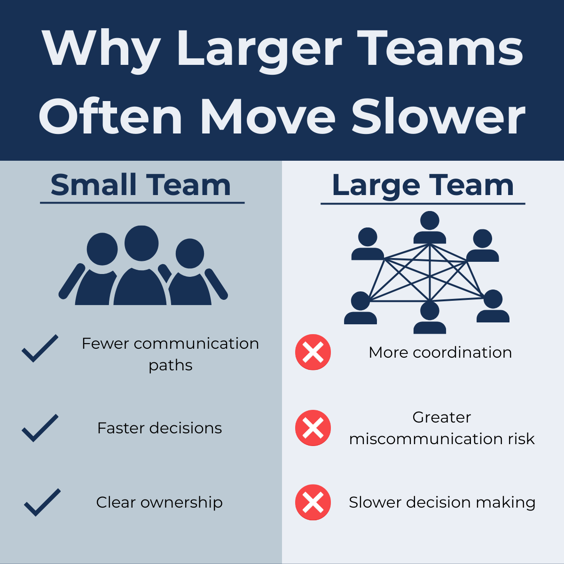
Every developer added to your team increases the number of communication paths between team members.
With a small team, communication is straightforward. Everyone understands priorities, decisions happen quickly, and information flows naturally.
As teams grow, the communication burden increases. Developers need to stay aligned with requirements, architecture decisions, and implementation details. More meetings appear, more documentation becomes necessary, and more time is spent coordinating instead of building.
This creates several challenges:
- More opportunities for miscommunication between team members
- Increased time spent in meetings, updates, and coordination
- Slower decision making as more stakeholders become involved
- Greater risk that different parts of the system are built inconsistently
In many cases, adding developers does not increase output proportionally. It increases the complexity of managing the work.
Coordination Overhead Can Slow Delivery
Software development is not just about writing code. It is about aligning people around the same goals and making sure every part of the system works together.
When a team grows, coordination becomes harder.
Developers may unknowingly work on overlapping problems. Changes in one area of the system can affect other areas unexpectedly. Without clear communication and strong leadership, the risk of rework increases.
Common signs of coordination overhead include:
- Developers waiting for decisions or clarification before continuing work
- Work being re-done because requirements were misunderstood
- Multiple people solving the same problem in different ways
- Increased time spent reviewing and reconciling changes
The larger the team, the more coordination effort is required to keep everyone moving in the same direction.
Larger Teams Also Increase Cost
Another factor often overlooked is cost.
Adding more developers does not just increase payroll. It increases the overall cost of running the team. More people require more management, more infrastructure, and more time spent coordinating work.
At the same time, productivity gains may not scale with team size. A team that doubles in size rarely produces double the output.
In some cases, organizations find that a smaller team of experienced engineers can accomplish more than a larger team of less experienced contributors.
Right-sizing the team helps organizations balance delivery speed with responsible cost management.
The Role of Clear Ownership and Leadership
When teams grow large, one of the first things that suffers is clarity.
Who owns the architecture? Who defines priorities? Who makes final decisions when technical disagreements arise?
Without clear ownership, teams can spend significant time debating direction instead of moving forward.
Smaller teams make it easier to establish strong leadership roles and maintain alignment. These roles often include:
- Product Owners who translate business needs into clear priorities
- Technical leaders who guide architecture and coding standards
- Senior engineers who mentor the team and maintain consistency
When these roles are well defined, teams can move faster because decisions are made quickly and everyone understands the direction.
Signs Your Team Might Be Too Large
Not every team needs to be small, but there are clear signs when growth is creating friction instead of progress.
Leaders may notice that:
- Adding developers does not significantly accelerate delivery
- Communication and coordination consume a growing share of the team’s time
- Work frequently needs to be revisited or corrected due to misalignment
- Developers spend more time waiting on decisions than building solutions
These signals often indicate that the issue is not capacity, it’s structure.
In these situations, focusing on the right mix of skills and leadership roles can be more effective than continuing to add headcount.
Right-Sizing Your Team
The most effective engineering teams are intentionally designed. Instead of asking how many developers a project requires, strong leaders ask a different question:
What is the smallest team that can reliably deliver the outcome we need?
Right-sizing a team means balancing several factors:
- The complexity of the problem being solved
- The experience level of the developers involved
- The clarity of product direction and priorities
- The availability of specialized expertise when needed
Sometimes the answer is a smaller, more experienced core team. In other cases, it may mean adding specialized roles that remove bottlenecks rather than simply increasing developer headcount.
The goal is not to reduce talent. It is to ensure that every role on the team contributes meaningfully to delivery.
Building Teams That Move Faster
Software development will continue to evolve, but one principle remains consistent: effective teams are built intentionally.
Organizations that focus only on increasing headcount often run into communication challenges, coordination overhead, and rising costs. Teams that focus on structure, leadership, and the right mix of skills are better positioned to move quickly and deliver consistent results.
Emergent Staffing helps organizations identify the talent mix needed to support efficient, well-structured engineering teams. Whether that means strengthening leadership roles, adding specialized expertise, or helping teams scale responsibly, the goal is always the same: keep delivery moving without unnecessary complexity.
The fastest teams are not always the biggest. Often, they are simply the ones designed to work together most effectively.