How an IT Staffing Company Can Help You Prioritize Projects When Everything Feels Urgent
 Jacqui Vreeland

Introduction
Most IT teams don’t struggle because they lack work.
They struggle because they have too much of it.
New initiatives, system maintenance, production issues, and internal requests all compete for attention at the same time. Everything feels important everything feels urgent, and as a result, teams shift into a reactive mode where they are constantly responding instead of moving forward.
When that happens, prioritization becomes difficult. Progress slows, strategic work gets pushed out, and even though the team is busy, it doesn’t feel like the right things are getting done.
Understanding why this happens and how to correct it is critical for maintaining momentum.
Why Everything Starts to Feel Urgent
In most organizations, urgency builds over time.
It often starts with a few competing priorities. A new project is introduced while existing systems still need to be maintained. Then production issues arise. Internal requests increase. Before long, the team is balancing multiple streams of work that all seem equally important.
A common pattern we see is the same team being responsible for both maintaining systems and building new ones. When something breaks, it naturally takes priority. That pulls focus away from new development and makes it difficult to sustain progress on longer-term initiatives.
Without clear boundaries or additional support, teams default to reacting to what is most immediate, not what is most impactful.
The Impact of Poor Prioritization
When prioritization breaks down, the effects are felt across the entire team.
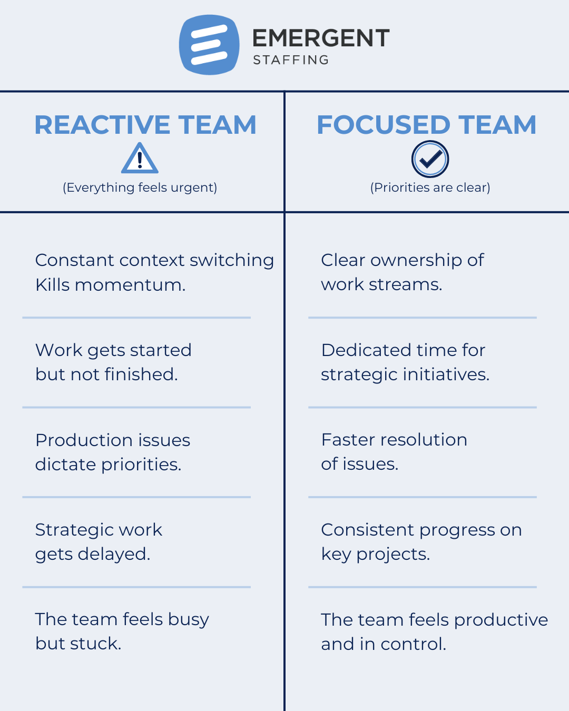
Developers are forced to switch between tasks frequently, which reduces efficiency and increases the likelihood of mistakes. Work gets started but not finished. Strategic initiatives lose momentum as urgent issues take over.
Over time, this creates a pattern where:
- Teams stay busy but struggle to complete meaningful work
- Long-term initiatives are delayed or deprioritized
- Progress feels inconsistent despite strong effort
This is one of the most frustrating situations for both leadership and technical teams. The issue is not a lack of talent or effort. It is a lack of sustained focus.
Why It’s Hard to Fix Internally
Many organizations try to solve this problem by pushing teams to work harder or by improving planning processes.
While those efforts can help, they often don’t address the root issue. The same people are still responsible for the same competing priorities. The environment hasn’t changed.
Even with better planning, unexpected issues will continue to arise. Production problems, urgent requests, and system maintenance will always demand attention. Without additional capacity or a shift in how responsibilities are handled, teams will continue to get pulled in multiple directions.
This is why prioritization challenges tend to persist even in well-managed teams.
How the Right Support Changes the Dynamic
One of the most effective ways to improve prioritization is to change the conditions the team is operating in.
Bringing in external support allows teams to separate responsibilities and protect time for high-priority work. Instead of constantly reacting, teams can follow through on planned initiatives.
This typically shows up in a few ways:
- Internal teams stay focused on strategic development work
- External support helps manage maintenance or overflow tasks
- Specialized expertise helps resolve complex challenges more quickly
When the pressure is reduced, prioritization becomes more realistic. Teams are able to stick to a plan instead of constantly adjusting to new issues.
The Long-Term Value of Specialized Expertise
One of the biggest misconceptions about bringing in external help is that it only solves short-term problems.
In reality, it often has long-term benefits as well.
When specialists work alongside your team, they naturally share knowledge. They introduce new approaches, help improve workflows, and provide insight into areas where the team may not have deep experience.
Over time, this leads to:
- Better technical decision-making
- More efficient processes
- Increased confidence in handling complex work
That knowledge doesn’t leave when the engagement ends. It stays with your team, making them stronger and more capable moving forward.
Making Better Prioritization Decisions
Improving prioritization is not just about deciding what to work on. It is about making sure your team has the ability to follow through.
Leaders should step back and evaluate whether the issue is capacity, capability, or both. If the team is constantly reacting, missing timelines, or struggling to maintain focus, those are signs that the current structure may not be enough to support the workload.
In many cases, a small adjustment can make a significant difference. The right support at the right time can help stabilize delivery without overcomplicating the team.
Staying Focused as Demands Grow
As organizations grow, the demands on IT teams will continue to increase. More systems, more users, and more initiatives all add to the complexity.
Teams that are able to maintain focus and prioritize effectively are better positioned to keep up.
At Emergent Staffing, we can help create that environment by providing the right mix of capacity and expertise when it’s needed most. Not by replacing your team, but by supporting it in a way that allows it to operate more effectively.
In the end, prioritization is not just about deciding what comes next. It is about making sure your team can follow through and deliver.